
Philippians 4:8
Finally, brethren, whatever things are true, whatever things are noble, whatever things are just, whatever things are pure, whatever things are lovely, whatever things are of good report, if there is any virtue and if there is anything praiseworthy—meditate on these things.
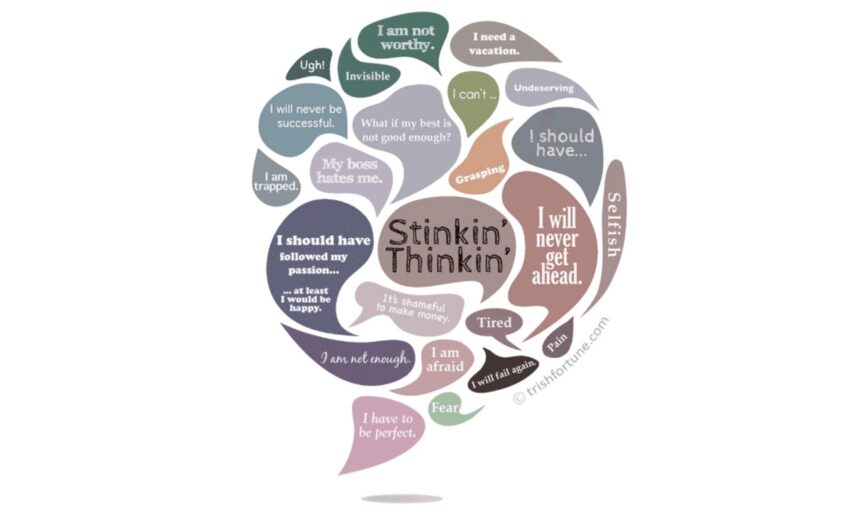
See if you relate to the whirlpool of Stinkin’ Thinkin’, where the downward spiral of one bad thought spirals into a descending cascade of stress, shame, and despair:
You have heard and perhaps memorized Philippians 4:8 (above), knowing this is what you ought to do. And then…
You have tried—to no avail—to think on the true, noble, pure, lovely, just, virtuous, and praiseworthy blessings in your life. It’s simply not happening. And then…
Everyone tells you to look on the bright side, but that feels artificial, fake, and forced. And honestly, you may have a hard time thinking of something to be grateful for. And then…
You feel like an utter failure. Not only do you feel like an incompetent Christian, but that judgmental guilt grabs hold of you like superglue. What kind of person can’t meditate on the good things in life? And then…
You wonder what is wrong with you. You can’t seem to think clearly, and have no idea how to straighten the broken, negative thought patterns that are persistently ingrained in your head.
You are not alone. Most people have at least one (or more) distorted thinking pattern which leads to this whole domino effect; they just don’t know how to stop it.
What’s even harder is that these thoughts lead to bad feelings, which in turn lead to behaviors you wish you hadn’t engaged in. Now, you’re reaping the unfortunate consequences of your actions.
Or, you are utterly paralyzed with fear at making decisions that you don’t do anything at all.
Take a look into a typical distorted mirror of Stinkin’ Thinkin’, and identify where you see yourself.
- Black-or-White Thinking (aka All-or-Nothing): There is no gray area here, nor does it allow God to be considered as an alternative option. Instead, it’s either one or the other.
“If my kids aren’t successful, then I’m a total failure as a parent.”
“Either I marry this person or end up being single the rest of my life!”
- Catastrophizing (aka Worst-Case Scenario): This happens to be the most common distortion, which puts you as the doomsday predictor of your life instead of trusting God with your future. You look into their crystal ball, seeing only the horrible “what if” things that might await you, and endless anxiety-producing scenarios play out in your head.
“I’m probably going to end up being poor and destitute in my old age with no one to love me.”
“What if I fail this test, and then I can’t get into a good college? I may as well kiss my career goodbye.”
- Magnification/Minimization: You focus on putting unfair weight on life’s stressors as well as on your perceived negative personality traits. God’s blessings and gift, then, become miniscule in comparison.
“Nobody will ever hire me because I’m no good at anything.”
“I may be empathetic, but so what? That doesn’t help me pay my bills.”
- Labeling: You attach a negative, critical personality trait as you put yourself down—which means, you are also dismissing the beautifully, wonderfully way that God made you.
“What’d I tell you? I’m always an idiot and say the wrong thing.”
“What’s the point of even talking when I never have anything important to say.”
- Feelings are not facts (aka emotional reasoning): Even if evidence exists to the contrary, you insist your feelings are true. Instead, your emotions are signaling there is a problem with your core beliefs about yourself.
“I feel like no one likes me.”
“I feel like I am a horrible parent.”
“I feel like God doesn’t love me.”
- Should-ing: You put unrealistic expectations on yourself, whether they stem from yourself, your parents, your church, friends, coworkers, or spouse. You persist on shaming yourself when you are not perfect, even though God has never called you to be perfect.
“I should be a stay-at-home mom (or dad) so my children aren’t raised by other people.
” I should be working so I contribute to society.”
“I shouldn’t be feeling this way.”
- Mental Filtering: You choose to focus only on the negative events of a situation, and assume the entire event was terrible. You don’t recognize the mercy and grace God has extended, nor do you see the event as positive.
“I forgot to say four lines of my speech. The whole thing was a disaster!”
“I was ten minutes late to my appointment, and now the whole day is ruined!”
- Mind Reading: Even amongst all the Marvel and DC Comic superheroes, not one has been given the gift of reading minds. You put yourself in place of God, assuming you know what someone is thinking or feeling, and then react poorly to that untrue assumption. When that happens, arguments ensue because you have created a problem where one doesn’t exist.
“I know what you’re thinking, and you can’t be more wrong.”
“I know what you’re feeling, and you are completely dismissing me!”
- Fortune Telling: You know, or rather think you know, what is going to happen. This is different than “what-if” catastrophizing since you are absolutely certain rather than wondering if something will happen. In doing so, you eliminate God from the equation.
“I know that if I go on that plane, I am going to have a panic attack.”
“I know when I see Jaeda at the grocery store, I’m going to lose my temper.”
- Personalization: No matter what goes wrong, you figure it’s your fault. You’re the reason why things turned out badly. You ignore we live in a fallen world, with people acting terribly (which likely has nothing to do with you).
“It’s all my fault my kids turned out the way did.”
“It’s all my fault that the boss was in such a foul mood.”
Did you find yourself saying, “Oh, I do this one!” or “That one is sooooo me!” Awareness is the first step in taking control of your Stinkin’ Thinkin’.
It is absolutely possible to change these patterns. It’s also understandable you don’t know where to start. You simply don’t know what you don’t know.
Yet, while you can identify the distortions you use, God puts us into community because we are meant to support, encourage, and strengthen each other. We can’t live in a vacuum of our thoughts since all we see is the cobwebs of dusty dirt. We need accountability. We need others’ perceptions rather than the algorithm of our own mind.
Don’t be afraid to reach out to a pastor, mentor, or trained professional in order to get help changing your thoughts so you can be free to meditate on the good things.
It would be nice to be free of all your Stinkin’ Thinkin’ and live the way God intends you to live rather than being stuck in the unproductive world of distorted thoughts and perceptions.
It’s never too late to renew your mind and become whom you’re created to be. Reach out today and begin the healing process!